

For small business owners, tax season is not just an annual chore; it is a final exam on your financial record-keeping throughout the year. The difference between a stressful tax bill and a manageable one often comes down to one thing: knowing which expenses you can deduct. A tax deduction reduces your taxable income, meaning you pay taxes on a smaller portion of your hard-earned revenue. In 2026, significant legislative changes have made some deductions permanent and expanded others, creating new opportunities for savings. Understanding the comprehensive small business tax deductions list is not just about compliance—it is a core strategy for improving your bottom line.
The 2026 Tax Landscape: What Has Changed
Before diving into specific deductions, it is crucial to understand the new rules shaping this year’s filings. The passage of the One Big Beautiful Bill Act (OBBB) in 2025 has ushered in a more stable and, in many ways, more favorable tax environment for small businesses.
Several key provisions are now permanent. The 20% Qualified Business Income (QBI) deduction, which was originally set to expire, is now a permanent fixture of the tax code. This allows eligible pass-through entities—such as sole proprietorships, LLCs, and S corporations—to deduct up to 20% of their qualified business income. Starting in 2026, a new $400 minimum deduction applies to taxpayers with at least $1,000 of QBI, ensuring even those with lower incomes benefit.
100% bonus depreciation has also been permanently restored, allowing businesses to immediately deduct the full cost of qualifying assets in the year they are placed into service. The Section 179 expensing limit has been raised significantly to $2.56 million, with a phase-out threshold of $4.09 million, making it easier to write off major equipment purchases.
Additionally, the state and local tax (SALT) deduction cap has jumped from $10,000 to $40,000 and will continue to rise by 1% annually through 2029, providing relief for businesses in high-tax states.
Operating Expenses: The Foundation of Your Deductions
The backbone of any small business tax deductions list is the category of operating expenses—the ordinary and necessary costs of running your day-to-day operations.
Advertising and Marketing
Any reasonable expense incurred to promote your business is deductible. This includes digital and social media ads, website design and maintenance, email marketing subscriptions, traditional print and radio advertisements, and promotional events. For e-commerce retailers, online fitness coaches, and content creators, these deductions can be substantial.
Bank Fees and Interest
Fees directly related to your business accounts are deductible, including monthly service fees, annual fees for business credit cards, and interest on business loans and lines of credit. This ensures you are not paying taxes on money that simply passes through to financial institutions.
Business Insurance
Premiums for insurance policies that are ordinary and necessary for your business are fully deductible. This includes general liability, property, casualty, professional liability, and business interruption insurance. If you protect your business with coverage, the IRS allows you to deduct that cost.
Contract Labor and Professional Fees
Payments to independent contractors, freelancers, and subcontractors are deductible business expenses. If you pay a contractor more than $600 during the year, you must also issue them a Form 1099-NEC. Additionally, fees for professional services such as accountants, attorneys, consultants, and tax preparers are fully deductible.
Office Supplies and Equipment
Everyday items like paper, pens, printer ink, postage, and software subscriptions are deductible in the year they are purchased. For larger equipment such as computers, machinery, and office furniture, you have choices. You can either depreciate the cost over several years or, under Section 179, deduct the full purchase price immediately—up to $2.56 million for qualifying property placed in service by December 31, 2026.
Rent and Utilities
If you lease office, retail, or warehouse space, the rent is 100% deductible, provided it is a reasonable amount and you are not building equity in the property. All necessary utilities for that space—electricity, gas, water, trash collection, phone lines, and internet—are also fully deductible.
The Home Office Deduction
For those who operate their business from home, the home office deduction can be a significant tax saver. To qualify, you must use a portion of your home exclusively and regularly as your principal place of business. Working from a kitchen table used for both business and family dinners does not qualify.
You have two methods to calculate this deduction. The simplified method allows you to deduct $5 per square foot of home office space, up to a maximum of 300 square feet, or $1,500. The actual expense method requires you to calculate the percentage of your home used for business and apply that percentage to your total home expenses, including mortgage interest or rent, utilities, homeowner’s insurance, repairs, and depreciation. While this method can yield a larger deduction, it requires meticulous record-keeping.
Vehicle and Travel Expenses
If your business requires you to get behind the wheel, you can deduct those costs. You have two options for deducting vehicle expenses. The standard mileage rate allows you to deduct a flat rate for every business mile driven. For 2026, this rate is 72.5 cents per mile, plus parking fees and tolls. The actual expenses method allows you to deduct the actual costs of operating the vehicle for business, including gas, maintenance, repairs, tires, registration fees, insurance, and depreciation. You must choose one method per vehicle and maintain detailed mileage logs.
For overnight business travel, you can deduct transportation costs (airfare, trains, car rentals), lodging, baggage fees, and incidental costs. Business meals during travel are typically 50% deductible, provided they are not lavish or extravagant.
Employee and Retirement Benefits
Investing in your team also provides tax advantages.
Salaries and Payroll Taxes
Wages, salaries, bonuses, and commissions paid to employees are deductible, along with the employer’s portion of payroll taxes (Social Security, Medicare, and unemployment taxes).
Health Insurance
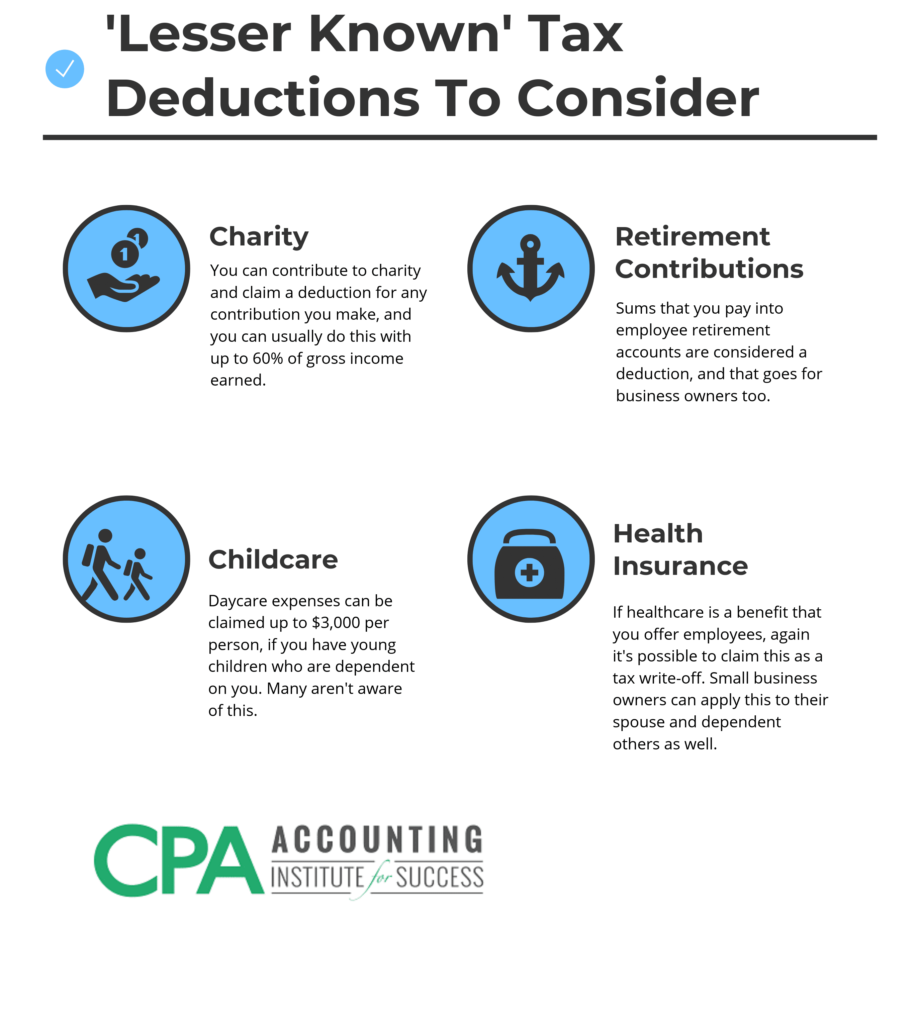
Premiums paid for group health insurance are fully deductible. For self-employed individuals, health insurance premiums for yourself, your spouse, and your dependents are also deductible directly from your gross income. Contributions to Health Savings Accounts (HSAs) are also deductible, with 2026 limits rising to $4,400 for individuals and $8,750 for family coverage. HSAs offer a “triple tax advantage”: contributions are tax-deductible, growth is tax-free, and withdrawals for qualified medical expenses are tax-free.
Retirement Plans
Contributions to qualified retirement plans are deductible and help secure your financial future. For 2026, business owners can contribute up to $24,500 to a 401(k), with catch-up contributions for those aged 50 and older. SEP IRA contributions can be up to 25% of compensation, with a maximum of $70,000. SIMPLE IRA contribution limits are $17,000.
Startup and Organizational Costs
Launching a new business comes with significant expenses, and the IRS allows you to deduct up to $5,000 of startup costs in your first year, provided your total startup costs are $50,000 or less. This deduction decreases dollar-for-dollar for costs exceeding $50,000. Qualifying startup costs include market research, advertising, employee training, and travel to find suppliers or locations.
If you form a corporation or LLC, you can also deduct up to $5,000 in organizational costs, such as state registration fees, legal fees for drafting operating agreements, and accounting setup fees. Any remaining costs must be amortized over 15 years.
Taxes and Licenses
You can deduct a variety of taxes and fees required to operate your business. This includes the employer’s portion of payroll taxes, state and local real estate taxes on business property, sales tax paid on business purchases (if not claimed as a credit), and professional license and certification fees.
Major Legislative Changes Impacting Deductions
The OBBB Act has introduced several other notable changes for 2026.
Research and Development (R&D) Costs
Domestic R&D expenses can now be immediately expensed rather than amortized over five years. This applies to costs incurred in 2025 and later, and certain small businesses can even retroactively apply full expensing to tax years 2022, 2023, and 2024 by amending prior returns.
Business Interest Expense Deduction
The calculation for the business interest deduction has been made more favorable. Businesses can now add back depreciation, depletion, and amortization when computing adjusted taxable income, effectively raising the ceiling on deductible business interest.
Employer-Provided Childcare Credit
Beginning in 2026, this credit has been significantly expanded. Employers can claim a credit of 40% of the costs of providing childcare services to employees, up from 25%, with a maximum annual credit of $500,000. Eligible small businesses can claim 50% of costs with a maximum credit of $600,000.
Charitable Donations
Corporate charitable deductions now have new limitations. Deductions are limited to contributions that exceed 1% of taxable income and do not exceed 10% of taxable income. For LLCs and other pass-through entities, charitable donations can still be deducted, but the rules regarding percentage limits apply at the individual level.
Strategic Year-End Planning
Maximizing your deductions requires proactive planning, not just reactive record-keeping.
Accelerate expenses by making necessary purchases before year-end. Prepaying rent, buying equipment, renewing insurance, and stocking up on office supplies can increase your deductions for the current tax year.
Defer income when strategically beneficial. If you expect to be in a lower tax bracket next year, consider delaying invoices so payments are received after December 31. This defers the tax liability to the following year.
Review your business structure. For profitable small businesses, an S-corporation election can offer tax savings by allowing owners to take part of their income as distributions instead of wages, potentially reducing self-employment taxes.
Conclusion
The small business tax deductions list for 2026 is more robust and favorable than it has been in years, thanks to permanent extensions of key provisions and expanded limits. From everyday operating expenses like rent and software to major investments in equipment and R&D, understanding what you can deduct is essential to minimizing your tax burden and maximizing your cash flow.
However, tax laws are complex and ever-evolving. Working with a qualified tax professional who stays abreast of these changes is not an expense—it is an investment that pays dividends in peace of mind and tax savings. By maintaining accurate records throughout the year and strategically planning your purchases, you can ensure that when tax season arrives, you are positioned to keep more of what your business earns.





Leave a Reply